

Dynamic Case Management
Enterprise grade AI-assisted case management solution for all industries
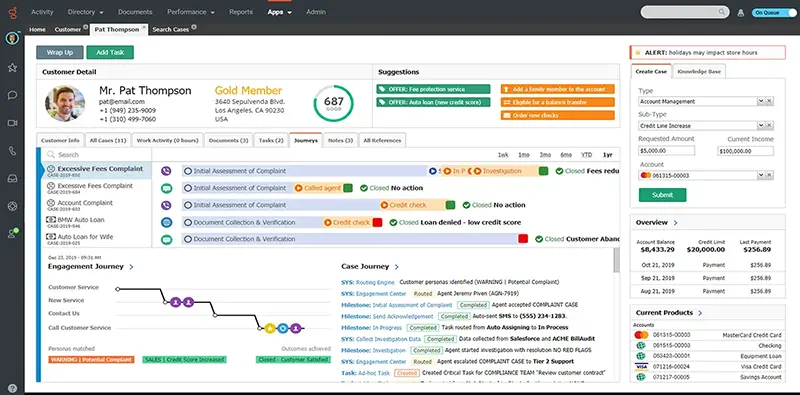
AI-Assisted Case Management by Eccentex
Eccentex Dynamic Case Management solution is part of Eccentex HyperAutomation Cloud and specifically designed for customers who want to automate and manage their Business Processes in an agile way.
Eccentex Dynamic Case Management leveraging federated AI capabilities to enhance customer and agent experiences across their entire journey.
The low-code/no-code capability of the platform supported by visual builders and generative AI capabilities allowing business users to automate their processes end-to-end with high flexibility and agility without depending on IT knowledge.
The system is adaptable enough to manage any core process, regardless of industry or use-case, and can be integrated with all necessary CX ecosystem components to deliver true Customer 360 view through a unified agent desktop.
The dynamic nature of this case management application enables the automation of non-linear/ad-hoc business processes as well, such as investigations, logistics, claims, fraud, patient journey management and more.
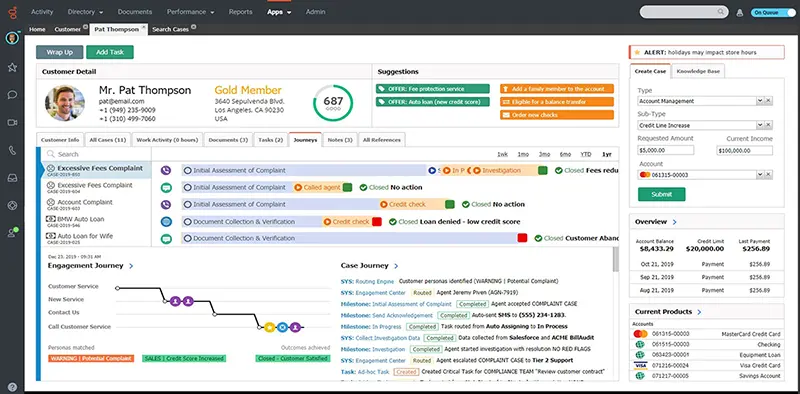
Major Business Benefits

Improved efficiency
Automate, optimize and reduce the need for manual intervention by enabling customers and users to navigate complex processes easily.

Increased visibility
Provide a comprehensive insight across all tasks and cases by enabling businesses to identify and resolve issues and make data-driven decisions.

Agility & flexibility
Eliminate the need for coding and IT support to business apps through visual process designers and generative AI prompts.

Orchestrating case work end-to-end
Working on cases often requires the collaboration of multiple departments and business units to jointly deliver the desired result. When it comes to unified processes, data sharing, shared KPIs and goals, it’s important to have a system that is able to orchestrate all tasks across all participants seamlessly.
Eccentex IWA – Intelligent Work Automation includes an AI Rule Engine that automates the decisioning about who needs to work on what task and when and organizing the case distribution according to assigned priorities and due dates.
The automated case distribution enables stakeholders to maintain the fair workload balance between the available resources automatically and assign, re-assign cases between resources groups to ensure the timely fulfillment of all customer commitments.


Share the right information in real-time
Unify and attach all web-forms, documents, content and data together into a single case file, and provide employees access to this complete set – ensuring they can collaborate and work towards the desired outcome together in real-time.
Automatically pull and push data between other 3rd party systems. Display information to employees with a 360-degree customer view that highlights the most important case-related data in each step across the customer journey.
AI-Assisted Case Management Automation for any Industry
Our products are capable of adapting to many use-cases, ranging from complex to simple
and low-volume to high-volume. Here are some of our specialities.

Dynamic Case Management for Financial Services
Automate and optimize your banking, insurance, and financial services processes such as Mortgage Application, Claims Processing, Wealth Management, Dispute Resolution, and more.
Reduce the need for manual intervention and enable better CX even through complex processes.

Dynamic Case Management for Government & Public Sector
Provide a comprehensive insight across all citizen management processes and tasks regarding Justice Cases, Eligibility Verification, Investigations and Complaints Handling.
Enable your organization to identify and resolve issues and make data-driven decisions.

Dynamic Case Management for Consumer Markets
Automate Customer Service, Fulfillments, Leads and Loyalty Management processes across your entire value chain. Capture customer leads, assign opportunities and prioritize delivery based on your value segmentation.
Treat all your customers like VIPs!


End-to-end Case-work Automation
Most case-based activities involve more than one person and more than one department. HyperAutomation Cloud (HAC) helps knowledge workers, case managers, service agents, partners and 3rd party resources collaborate, even from home.
To satisfy every KPI and deliver all customer commitments on-time, HAC automates repetitive tasks such as pulling information, making rule-based decisions, proactively notifying stakeholders of SLAs and assigning resources to each task autonomously.
Dynamic Case Management
Everything you need for enterprise process automation.

Dynamic Workflows
Manage structured and unstructured processes that have their own forms, participants, SLAs, and business rules.

360-Degree Case View
Use an omnichannel enabled 360-degree desktop to view and manage all case-related data, even if they are managed through 3rd party systems.

Case Hierarchies
Manage complex multi-stage cases. Keep track of related issues, documents, and allow teams to collaborate across the entire case lifecycle.

Manage Ad-hoc Tasks
Create unplanned tasks, such as requesting a review or approval, perform investigations and assign them to individuals or teams.

Intelligent Assignments
Assign cases and tasks to employees or teams based on their workload, skills and proficiencies or allow them to work on their own priorities.

Goals, Deadlines and SLAs
Set due dates for any case or specific task that needs to be resolved within an SLA and escalate at-risk items or notify stakeholders.

Email-to-Case
Capture emails from multiple addresses and automatically create a case that can be prioritized and assigned to the right resources.

Content Management
Give case workers easy access to all case-related emails, documents, and attached files even if they are stored in 3rd party systems.

Role-based Security
Ensure prudent handling of sensitive case data and information and protect it from unauthorized access and cyber security threats.

Task Queues
Manage tasks and cases coming from multiple sources and assign them to individuals, teams, departments, or specialized queues.
Enterprise-grade Case Management
Customers choose Eccentex because it’s the power they want with the flexibility they need.

Integration
Quickly connect Eccentex apps to any major systems through standard connectors. Sync data, invoke actions and deploy custom APIs.

Scalability
Execute your strategy on a platform that can extend to a global scale and volumes, powered by HyperAutomation Cloud.

Flexibility
Leverage the power of the low-code platform that enables non-technical people to develop business applications easily.

Extensibility
Optimize workflows and processes, leverage federated AI services and use data and analytics tools to improve productivity.

Real-time monitoring and insights
Eccentex HyperAutomation Cloud equipped with a built in BI – Business Intelligence feature that provides advanced analytics and real-time dashboard capabilities to organize your interaction data, track case performance, identify trends, and make data-driven decisions. Define custom KPIs and derive business-specific insights.

Additional resources

3 Steps Survival Guide to Recession
3 Steps Survival Guide to Recession for Customer Service Leaders Recession is a period of general economic decline that is typically characterized by three early signs: 1. Increased unemployment rate 2. Declining housing market 3. Drop in the stock market When these...
How AI-Driven Case Management Elevates Customer Service
We all know leveraging AI and automation can revolutionize service operations by enhancing efficiency and effectiveness while saving time and effort. Here’s how you do it!

Navigating Digital Transformation in an Inflationary Economy
Inflation can pose significant challenges to businesses, affecting everything from consumer spending to operational costs. In such an economic environment, digital transformation becomes not just a strategic choice but a necessity for survival and growth. However,...
Get in touch with experts