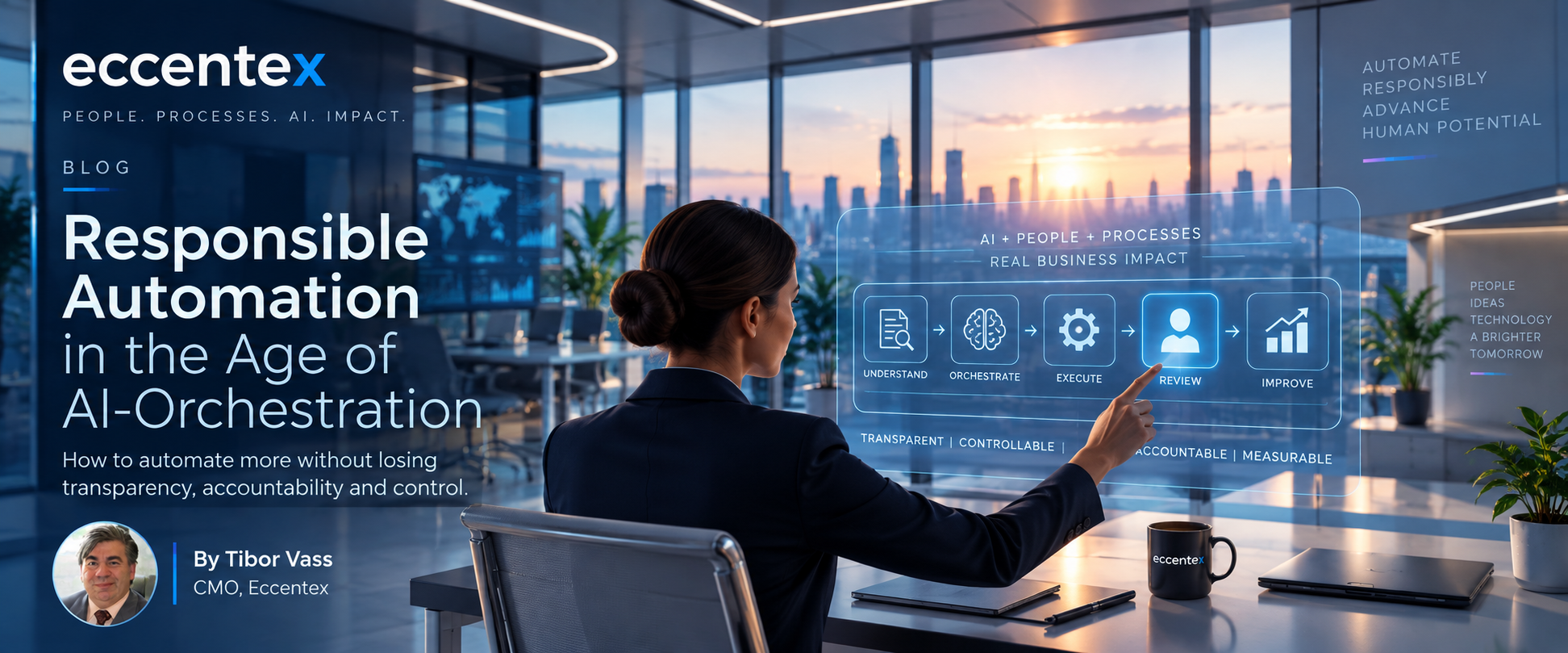
Responsible Automation in the Age of AI Orchestration
How better I could start blog than with a quote from Mark Twain “I have made this letter blog longer than usual, only because I have not had the time to make it shorter.” Mark Twain – Lettres Provinciales, December 4, 1656
So, be prepared for a bit longer than 2 minutes standard blog, but I hope you will find it useful – if you’ll have time to read this thru.
AI is commodity in Business already, and becoming unavoidable in very short term.
Better to acknowledge it and be prepare how to use it, unless you accept that your business will be aging out in much shorter time than the film cameras, DVD players or corded phones disappeared.
Then let’s ask the question that relevant and mandatory to be answered adequately: How do we automate more without losing transparency, accountability and human control?
Over the last decade, I have watched business automation evolve through several very different generations. Lately I personally participated in our company transformation from Zero AI products through AI-assisted solutions to AI first offerings that happened less than 18 months.
We started by digitizing paper processes. Then we automated repetitive tasks. We connected systems through BPM, integration platforms and APIs. We introduced robotic process automation. Later came machine learning, predictive analytics and conversational AI.
And now we have entered a fundamentally different phase.
AI is no longer simply another tool inside a business process.
AI is at the front of everything we offer. It can understand an email, interpret a document, summarize a case, search knowledge, recommend a decision, communicate with a customer, create content, prioritize work and increasingly execute complex business actions on behalf of people.
When these capabilities are orchestrated together, we are no longer talking about automating individual tasks.
We are beginning to automate judgment, coordination and action.
That changes the conversation. Fundamentally.
So, the question for business leaders is no longer simply: “What can we automate?”
I believe the much more important question is: “What should we allow to operate autonomously, and under what conditions?”
That is what Responsible Automation means to me.
Automation Has Changed. Forever.
Traditional business automation was relatively deterministic.
We created a rule: If X happens Do Y, then the system executed the instruction.
Even when the process became complicated, we could usually trace why something happened because somewhere there was a workflow, a rule, a decision table or piece of code defining it. In advance.
Then Generative AI changed this status quo.
An AI model does not necessarily follow a predefined decision tree. It interprets context and produces a probabilistic response. And AI orchestration takes this one step further.
Imagine an incoming insurance claim.
An AI service reads the customer’s email. Another extracts information from the attached documents. A language model summarizes the case. A fraud model evaluates anomalies. A knowledge service retrieves relevant policies. An AI agent recommends the next action. An orchestration layer decides which activity should happen next and performed by which AI service(s).
Potentially, all of this happens before a human touch the case.
This can create extraordinary productivity, but it can also create a new management problem:
Who, or what actually made the decision and why?
And this leads to the need to redefine few concepts.
Responsible Automation is more than Responsible AI
This distinction has become increasingly important to me, because most Responsible AI discussions concentrate on the model: accuracy, bias, privacy, security, explainability and appropriate use.
All of these are important, but enterprises rarely operate an AI model in isolation.
A real business outcome likely involve several models, enterprise data, business rules, APIs, documents, workflows, employees and external systems working together. In a random sequence.
The risk therefore doesn’t exist only inside the AI. It exists in the orchestration of the entire decision and execution chain.
A perfectly good AI model can still participate in a badly designed automated process.
That is why I think businesses need to move from thinking only about Responsible AI toward thinking about Responsible Automation.
Responsible Automation addresses a much broader question:
Can we understand, govern and, when necessary, interrupt the complete chain between intelligence and action?
Autonomy Should Never Mean Unaccountability
There is a misconception that human-centered automation means humans must approve everything.
I don’t believe that.
If every AI-generated decision requires manual approval, we eliminate much of the economic value of automation.
But the opposite extreme that may giving AI unrestricted autonomy, makes equally little sense for most enterprise environments.
The better model is Risk-adjusted Autonomy.
Consider three decisions:
- The first AI Agent changes the category of an internal service request.
- The second AI Agent authorizes a $15 refund.
- The third AI Agent recommends rejecting a $500,000 insurance claim.
Technically, AI might be capable of performing all three.
But should these actions have the same level of autonomy?
Clearly not.
The level of human involvement should increase with the risk, uncertainty, financial impact, regulatory sensitivity and reversibility of the decision.
This leads to a principle I believe will become fundamental to enterprise AI:
Autonomy should be proportional to confidence and inversely proportional to consequence.
- Principle #1 – High confidence + low consequence can justify high autonomy.
- Principle #2 – Low confidence + high consequence should trigger human involvement.
The interesting area lies between those two extremes. That is where AI orchestration becomes particularly valuable.
From HITL (Human-in-the-Loop) to HICC (Human-in-Contextual-Control)
We often talk about “human-in-the-loop.”
I increasingly think this description is too narrow.
Putting a person somewhere inside a workflow does not automatically create meaningful control. If an employee receives hundreds of AI recommendations every day and simply clicks Approve, technically there is a human in the loop.
Practically, there may be very little human oversight.
The objective should instead be human-in-contextual-control.
That means people can oversee and (fully) understand what is happening, intervene when necessary, override automated decisions, investigate exceptions and change the boundaries within which AI operates.
- Sometimes the human participates directly.
- Sometimes the human supervises.
- Sometimes the system operates autonomously and only escalates exceptions.
The important point is that accountability remains identifiable even when execution becomes autonomous.
Five Principles I Use to Think About Responsible Automation
After years of working with business process automation and, more recently, AI-assisted case management and AI orchestration, I have come to think about what the 5 minimum criteria of Responsible Automation are.
- Observability
- If AI participates in a business decision, the organization should be able to see that it happened.
- Able to see which AI service was used.
- Able to see what information was provided.
- What decision was made by the AI Agent and why.
- What happened afterwards.
Without observability, business governance becomes guesswork.
- Explainability
Not every neural-network calculation can be translated into a simple human explanation.
But all business decision should still be explainable.
A case manager may not need to understand the mathematics of a model.
But they should understand why a case was prioritized, which information influenced the recommendation, what policy or knowledge was consulted and what action the system proposed.
There is an important difference between explaining a model vs. explaining a decision.
For business operations, we often need the latter.
- Controllability
Every autonomous system needs boundaries.
- What can the AI recommend?
- What can it execute?
- What requires approval?
- When must it escalate?
- What happens when confidence falls below an acceptable threshold?
And perhaps most importantly:
- How do we stop it?
Control should be part of the base architecture, not an emergency feature added later.
- Accountability
Automation should never create an accountability vacuum.
Every automated process should have an identifiable owner.
That owner may delegate execution to software, AI models or agents, but responsibility for the business outcome remains organizational.
This is particularly important as companies begin deploying multiple AI agents.
We should never reach a situation where the explanation for a business decision becomes: “The AI did it.”
- Measurability
AI automation should continuously prove that it deserves the autonomy we give it.
Organizations should monitor more than productivity.
They should measure accuracy, overrides, exceptions, complaints, confidence levels, false positives, escalation rates and downstream business outcomes.
- If humans frequently override an AI recommendation, that is information.
- If one category of customers generates significantly more exceptions, that is information.
- If an AI agent performs well for six months and suddenly begins behaving differently, that is information.
Responsible Automation therefore isn’t a governance exercise performed before deployment.
It is a continuous operational discipline.
Interestingly, the Science Is Moving in the Same Direction
These principles are not only philosophical.
Modern AI governance frameworks increasingly treat AI risk management as a lifecycle rather than a one-time certification exercise.
The NIST AI Risk Management Framework, for example, structures AI risk management around four continuous functions: Govern, Map, Measure and Manage. It specifically emphasizes documentation, defined human oversight, continuous measurement and organizational accountability.
ISO/IEC 42001 similarly approaches AI governance as a management system: responsibilities, risk assessment, transparency, monitoring and continual improvement.
For me, the important lesson is that Responsible Automation should not become a compliance document sitting somewhere in a corporate repository.
It has to become part of the operating architecture.
This Is Where AI Orchestration Becomes Important
One reason I have become increasingly convinced about Platform-agnostic AI orchestration is that enterprises are unlikely to operate with a single AI.
- They will use many.
- One model may be better at document understanding.
- Another may provide conversational intelligence.
- Another may detect fraud.
- Another may generate better content.
- A specialized predictive model may outperform all of them for a particular operational decision.
The future enterprise AI architecture therefore may not be:
Business Process → AI
It may look more like:
Business Process → Orchestration → Multiple AI Services → Business Rules → Human Judgment → Action
And this changes the role of the automation platforms. Fundamentally.
Its job is no longer simply to move work from Step A to Step B. It becomes the control plane between intelligence and action.
The orchestration layer can determine which AI should be used, what context it receives, what it is permitted to do, when another model should validate the result, when business rules take precedence, and when a human must become involved.
This is one of the ideas behind the direction we are taking with Eccentex HyperAutomation Cloud that orchestrating AI, processes, enterprise systems, data and people while maintaining visibility and human accountability.
The objective is not to put Eccentex AI everywhere.
The objective is to allow organizations to use the right intelligence for the right task, while maintaining control over the overall business process.
And here comes my recommendation
Don’t Automate the Organization Out of the Process.
And there is another lesson I have learned from automation projects. The easiest way to automate a bad process is to automate it exactly as it exists.
AI makes that temptation even stronger because it can compensate for inefficiencies that previously required process redesign.
But making a bad process faster does not necessarily make it better.
Before asking where AI can replace work, I prefer asking:
What outcome are we trying to achieve?
Then:
- What should be eliminated?
- What should be deterministic?
- What should use AI?
- What should remain human?
- What should be fully autonomous?
- What should require approval?
- What should happen when something unexpected occurs?
That sequence produces a very different architecture than simply adding an AI agent to an existing workflow.
The Goal Isn’t Maximum Automation
This may sound strange coming from someone who has spent much of his career in business automation.
But I don’t believe the objective should be to automate everything.
The objective should be to create the best possible business outcome with the appropriate combination of machine intelligence and human judgment.
- There will be processes where 99% autonomy makes perfect sense.
- There will be others where AI should primarily gather information and advise a professional.
- And there will remain decisions where humans should retain final authority.
The sophistication is not in achieving the highest automation percentage. It is in knowing the difference.
My Simple Question for Business Leaders
When evaluating an AI automation initiative, ask yourself first:
“If this system makes the wrong decision tomorrow, can we understand what happened, identify who is accountable, intervene quickly – or reverse it, then improve the system?”
If the answer is yes, you probably have the foundations of Responsible Automation.
If the answer is no, – or don’t know, you are about to add one more AI that will not solve the problem but will amplify it.
The Next Generation of Automation Needs a Brake Pedal
We are entering an extraordinary period.
AI agents will increasingly communicate, analyze, decide and execute activities that previously required people.
I believe this will create enormous economic value.
But the most successful organizations will not necessarily be those that give AI the most autonomy.
They will be the organizations that learn where autonomy creates value, where judgment still matters, and how to move dynamically between the two.
A powerful car isn’t responsible because it drives slowly. It is responsible because its speed is matched by steering, visibility, instrumentation and brakes.
AI automation should be designed the same way.
So, my top 5 recommendation to you
- Automate aggressively but only where the evidence supports it.
- Keep humans involved where judgment matters.
- Measure everything.
- Make every important decision traceable.
- And never automate beyond your ability to remain in control.
That’s what Responsible Automation means in the age of AI orchestration.
Tibor Vass
CMO, Eccentex